High vs. Mid vs. Low Rise: Measurements and Brand Comparison Guide
We measured the front rise on hundreds of petite-friendly women's jeans across 14 brands, and here's the uncomfortable truth: a pair labeled "low-rise" can sit higher on your body than one labeled "high-rise." The word on the tag is almost decorative and if you're petite, it's the difference between jeans that fit and a growing pile of returns. Let's break down what "rise" really means, why the labels can't be trusted, and how to find your number.
First, what "rise" actually is
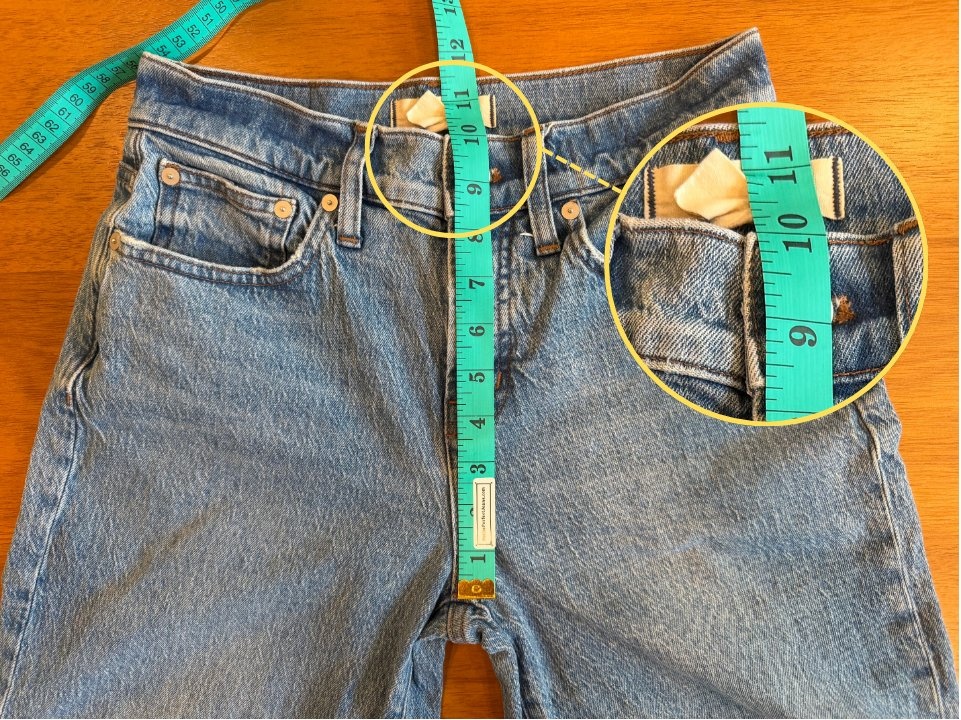
Rise is the distance from the crotch seam of a pair of jeans up to the top of the waistband. When a brand lists a single rise number, they're almost always talking about the front rise, measured up the front of the jean, not the back (the back rise is taller, which is why your jeans don't fall down).
That number is what determines where your jeans land on your body:
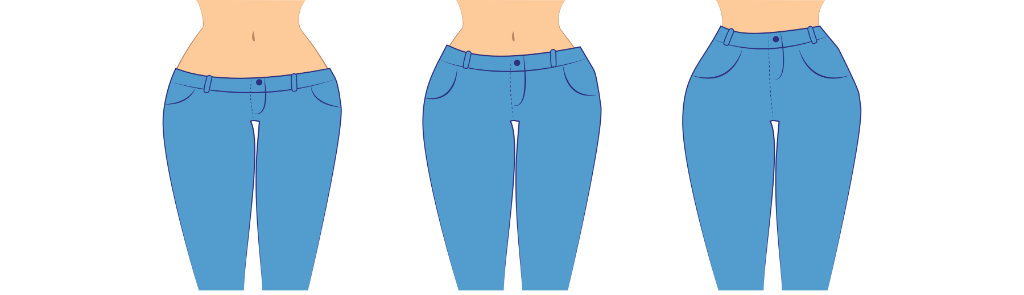
- Low-rise sits below your belly button
- Mid-rise lands right around or just below your belly button
- High-rise sits at or above your belly button, hitting closer to your natural waist
Simple enough in theory. The trouble is that "below your belly button" depends entirely on whose belly button we're talking about, which brings us to the part nobody puts on the product page.
Understanding your rise
Here's the thing brands conveniently ignore: the same jean, with the exact same rise measurement, lands in a completely different place on two different bodies. Where it lands depends primarily on your torso-to-leg proportion.
If you have a longer torso relative to your legs, a "high-rise" jean has more distance to climb before it reaches your natural waist, so it reads as mid-rise on you. If you have a shorter torso, that same jean vaults right up to (or past) your waist. This is why women can't just trust a label; bodies vary enormously in where their height is distributed.
The petite problem: When you're short, even a "long torso" may not be that long. Petite-specific jeans help, since they often adjust rise in addition to length and other proportions. But petite sizing is generally cut for women 5'2"–5'4", so if you're under 5'2", it can still be a struggle.
Add to that the fact that jeans are trending high right now, and petites get the short end of the stick (pun intended): more than half of all jeans fall into the high or ultra-high-rise category, and plenty of styles labeled mid or low still sit higher than you'd expect. (More on why in a minute.)
The practical upshot is that "what rise should I wear" is really "how long is my torso," and the honest answer starts with a tape measure. (For how to actually measure your torso and figure out your proportions, see our torso length guide.)
Once you know roughly how much rise it takes to hit your natural waist, you have a target number. And that's when you discover the labels are actively lying to you.
Rise labels (or should we say rise lies)
Here's where it gets annoying. Front-rise measurements aren't always published, so sometimes you have no choice but to rely on the description.
The problem? Rise labels are not consistent.
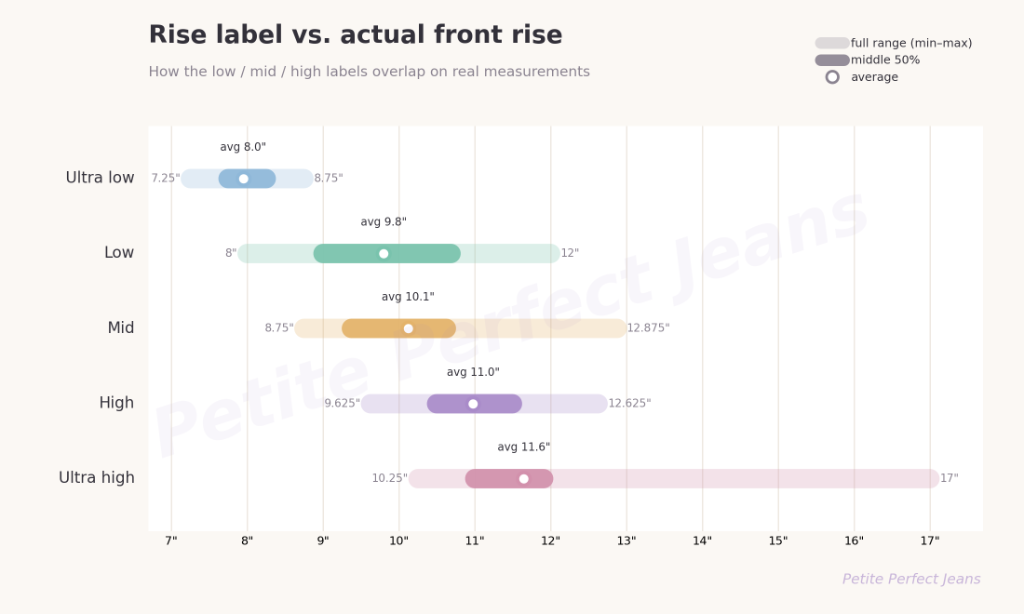
We pulled the published front-rise measurements for hundreds of women's jeans across 14 brands and matched them against their labels. The averages do climb in the right direction:
- ultra-low jeans about 7.9″
- low about 9.8″
- mid about 10.1″
- high about 11″
- ultra-high about 11.6″
So far, reasonable. But the ranges overlap so heavily that the label barely tells you anything:
- Jeans labeled "low-rise" run all the way up to 12″.
- Jeans labeled "high-rise" dip as low as 9.6″.
Read that again: a "low-rise" jean can physically sit higher on your body than a "high-rise" jean from another brand.
To make it concrete, a front rise of 10½ inches is called all three of these things:
- "Low-rise" by American Eagle
- "Mid-rise" by Levi's (the 501 '90s)
- "High-rise" by Quince
And it's not just cross-brand chaos; brands disagree with themselves. Lucky Brand's "Mid Rise Boy Jean" and its "Uni Fit" both have a 10½″ front rise, and Lucky calls one mid and the other high. Identical measurement, same company, two different labels on the same website.
Why is everything creeping upward? Because high-rise is having a long, dominant moment. High-rise has been the reigning trend for years now, and brands know "high-rise" sells, so the "high-rise" bucket has ballooned. In our data it was by far the largest category, with roughly three times as many styles as "low-rise." When a label becomes a marketing asset, it stops being a measurement. Everything wants to be called high-rise, so "high-rise" now spans a genuinely enormous range of actual heights.
You can see the pull toward tall rises brand by brand. Here's the lowest, average, and highest front rise we measured across brands on Petite Perfect Jeans:
| Brand | Lowest | Average | Highest |
|---|---|---|---|
| Abercrombie & Fitch | 9¼″ | 11⅛″ | 12¼″ |
| American Eagle | 8¾″ | 10⅞″ | 13″ |
| Banana Republic | 9½″ | 11¹⁵⁄₁₆″ | 17″ |
| Frame | 8½″ | 10¼″ | 12″ |
| Gap | 9″ | 10⁵⁄₁₆″ | 12″ |
| Hollister | 7½″ | 9¹⁄₁₆″ | 11¼″ |
| J.Crew | 10¼″ | 11⅜″ | 12¼″ |
| Kut from the Kloth | 8¾″ | 9¹⁵⁄₁₆″ | 11¼″ |
| Levi's | 8¾″ | 10¹¹⁄₁₆″ | 12½″ |
| Lucky Brand | 7¼″ | 9¹³⁄₁₆″ | 11¾″ |
| Madewell | 9½″ | 10¹⁵⁄₁₆″ | 13″ |
| Mother | 9⅛″ | 10″ | 12⅞″ |
| Paige | 10″ | 10¹⁵⁄₁₆″ | 12⅝″ |
| Quince | 9¾″ | 10¾″ | 12″ |
Notice how the averages skew high. Nearly every brand lands above 10 inches on average, and several (Abercrombie, J.Crew, Banana Republic) average around 11 inches or more. If you actually want a mid- or low-rise on a petite frame, you're swimming against the entire industry's tide.
What to actually do about it
Stop shopping by the word. Start shopping by the number. The fix is boring but it works: figure out your own target front rise, then read the measurement, not the label. Concretely:
Find your number. Measure the rise on a pair of jeans you already own and love, crotch seam straight up to the top of the front waistband. That inch count is your target. (Our measurement guide walks you through it.)
Hunt for the measurement, not the adjective. Most brands bury the actual front-rise number in the product details or size chart. Find it. A "mid-rise" at your target number will serve you better than a "high-rise" that's two inches off.
Treat the label as a rough filter, nothing more. Use "mid-rise" to narrow a search, sure, but confirm with the inches before you trust it. A 9½″ "mid-rise" and an 11″ "mid-rise" are a full inch and a half apart, and on a petite frame an inch and a half is the difference between flattering and boob support.
Keep a cheat sheet. Once you know that, say, 9–10½″ is your sweet spot, you can scan measurements across brands and ignore the marketing entirely. Two minutes of tape measure saves you a return.
Yes, some jeans have no published rise, in which case you're stuck with the description and the hope that it's roughly consistent with the brand's other jeans. But for everything else, your tape measure doesn't lie, and once you know your range, you can filter out a lot of duds early.
Already know your rise?
Search jeans by your measurements →