Short Torso vs Long Torso: How to Measure and Shop for Your Petite Proportions
If you've ever pulled on a pair of petite jeans and had them ride up to your bra, or bought a pair that fit at the waist but puddled at your feet, your torso proportions are probably the reason. Height is one number, but whether more of that height lives in your torso or your legs changes everything about how jeans fit. Most women's jeans are designed around balanced proportions, and that's no different for petites. If you're not balanced and you have a hard time finding jeans, the proportions may be a reason why.
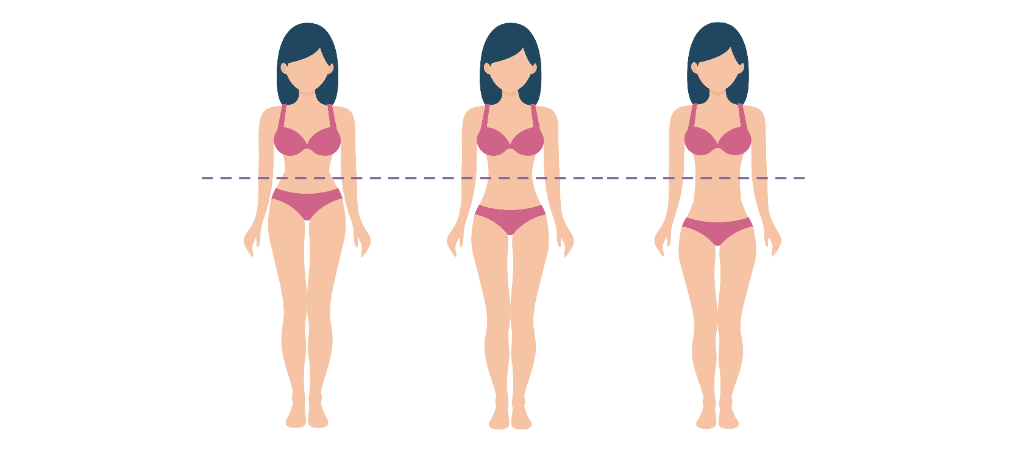
There are three types:
- Long torso / short legs. More of your height is in your torso. You're more likely to find jeans with an appropriate rise, but inseam is a major challenge; even petite-specific inseams can be too long.
- Balanced. Your torso and legs are roughly evenly proportioned. Standard petite sizing was designed for you and you likely have more options than other petites.
- Short torso / long legs. More of your height is in your legs. Inseam is less of a problem, but rise is, especially in today's high rise environment. High-rise jeans climb to your chest, and what brands call "low rise" often lands mid or even high on you.
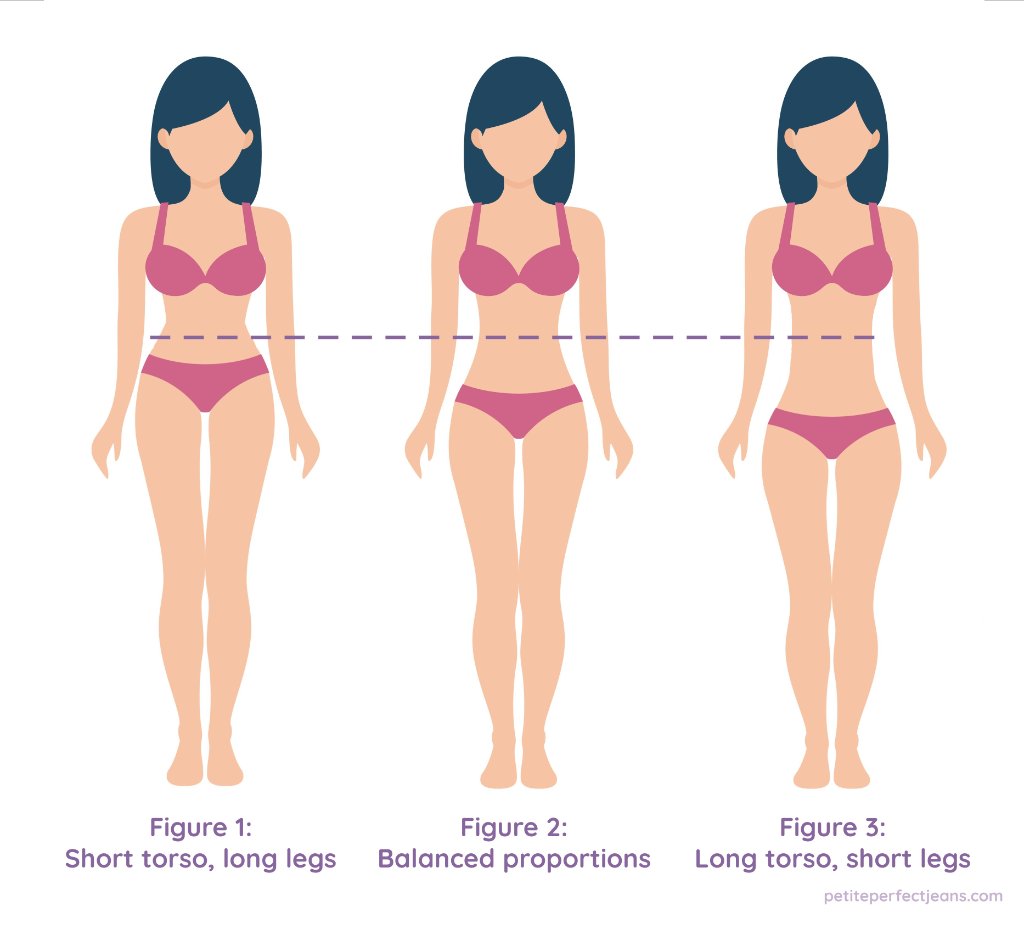
The further you are from balanced, the more you'll feel it when you shop. Knowing where you fall helps you stop blaming yourself (or the jeans) for a fit problem that's really just a proportion mismatch.
What to do with this info
If you're long torso / short legs
Your main challenge is finding a short enough inseam.
Look for extra-short inseams off the rack. Standard petite inseam is usually 28". Abercrombie & Fitch and American Eagle are two of the better options for short inseams since both offer a bunch of options with extra-short inseams. A&F jeans have inseams starting at 22.8" and AE starts at 25".
Consider cropped and ankle styles. Many petites end up in a "full length" jean that's technically a cropped style. This can work, but note that cropped styles change more than just the inseam; the overall proportions shift too, which tends to work better in less structured silhouettes like straight or baggy fits. Kut from the Kloth has a solid range of ankle and crop styles across different cuts.
Get them hemmed. If everything else fits and only the inseam is off, hemming is one of the easier and more affordable tailoring fixes. Just wash your jeans first (if you do wash your jeans) to account for any shrinkage before you bring them in.
If you're balanced
Standard petite rises and inseams are more likely to work with your proportions with one important caveat:
If you're under 5'1", standard petite sizing may still run long in rise and inseam. Most brands size petite for women 5'3"–5'4" and under, which means if you're 5'1" or shorter, there's already a gap of several inches. The standard 28" inseam may still be too long, and even low rises (around 9" these days) can sit higher than you'd like.
If you're short torso / long legs
Your main challenge is finding a short enough rise.
Look for low or super-low rise off the rack. Most jeans today skew high (10"+), but lower options exist. American Eagle, Gap, and Mother (if you're open to a splurge) all carry styles around 9".
Shop petite over standard sizing. With longer legs you might be tempted to skip petite sizing but keep in mind that petite cuts generally have a lower rise than their standard counterparts. Instead of a standard size, try the next size up in petite instead.
Try thrifting. Today's "low rise" is not the low rise of the early 2000s. If you want a rise under 8", resale and thrift shops are your best bet.
Note: tailoring is always an option, but lowering a rise is a more complex alteration than hemming which means it'll cost more.
Not sure which type you are?
If you have a hunch, the shopping section above is probably enough to get started. But if you want to confirm or you're borderline and need more precision, here are two ways to check.
The quick check: your inseam
Your jean inseam is a reasonable stand-in for leg length. If you know the inseam of a full-length jean that fits you well (one that hits at or just above the floor with a normal break at the shoe), you can use the grid below to get a directional read.
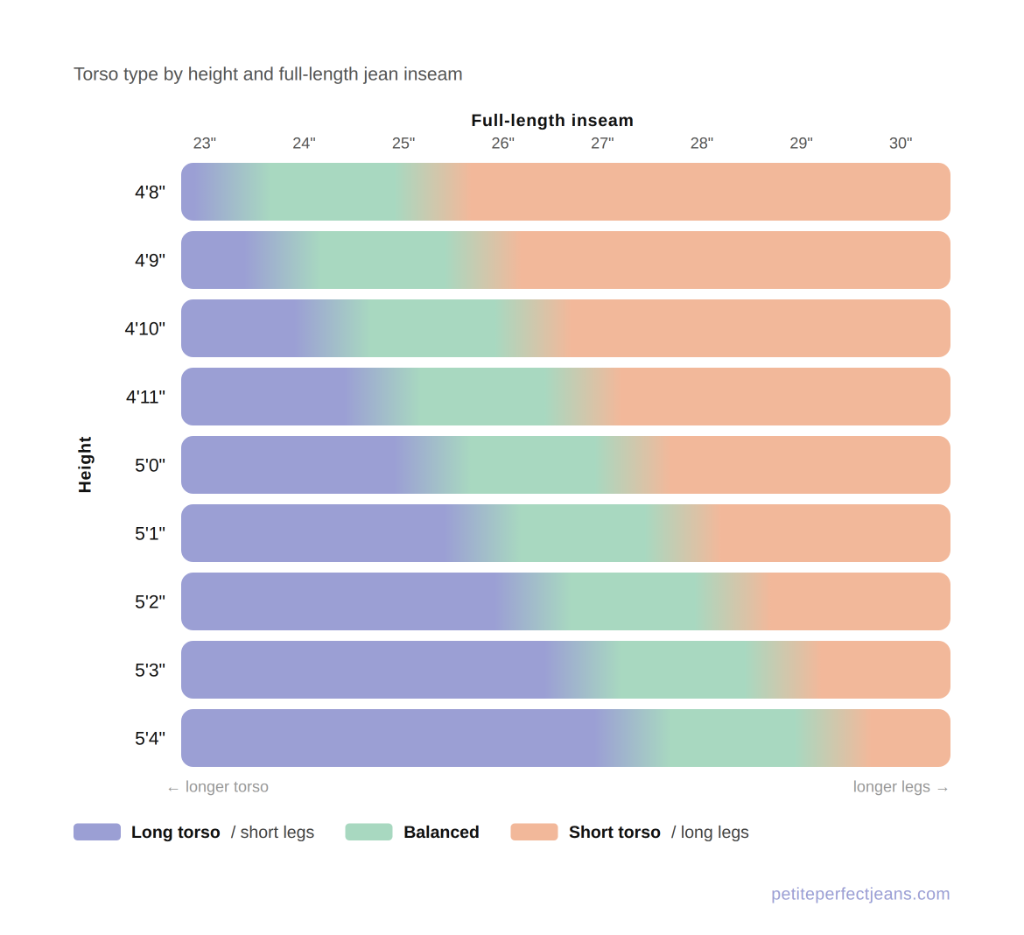
Find your height, follow it to the column matching your usual full-length inseam, and the color tells you which bucket you're in. This is a rough guide, not a precise measurement, but if the answer feels obvious, you can stop here.
The precise method: sitting height ratio
If you're borderline, or want to know exactly how long- or short-torsoed you are, measuring your sitting height takes a few minutes and gives you a more precise answer. This is the same measurement anthropometrists use.¹
You'll need: a tape measure, a hard flat chair, something flat like a book or ruler, and painter's tape for marking.
1. Measure your total height. Stand barefoot against a wall, heels together, head level. Place the flat object on your head and mark the spot on the wall. Measure from the floor to the mark.
2. Measure your sitting height. Sit up straight on a hard, flat chair with your thighs parallel to the floor. Sit as tall as you can without straining, head level. Mark the top of your head against the wall behind you, then measure from the seat of the chair up to that mark.
Tip: The most common measuring mistake is slouching, or using a chair where your feet dangle or your knees sit above your hips. Either will throw the number off. The seat should be hard and level; sit at your full height as if you're standing, just seated.
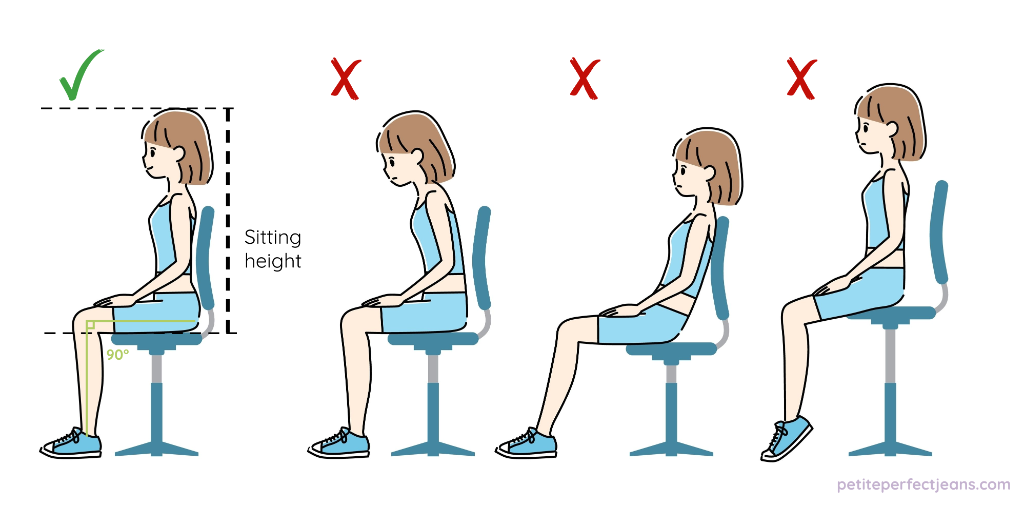
No appropriate chair? You can also measure sitting height from the floor by sitting against the wall on a hard floor and marking the top of your head, then measure from the floor to the mark.
3. Calculate your ratio: sitting height ÷ total height
Example: 31" sitting height ÷ 60" total height = 0.517 → balanced
| Your ratio | Type |
|---|---|
| Above 0.54 | Long torso / short legs |
| 0.50 – 0.54 | Balanced |
| Below 0.50 | Short torso / long legs |
In real inches, by height:
| Height | Long torso (sitting height greater than) | Balanced range | Short torso (sitting height less than) |
|---|---|---|---|
| 4'8" | 30.3" | 28"–30.3" | 28" |
| 4'9" | 30.8" | 28.5"–30.8" | 28.5" |
| 4'10" | 31.3" | 29"–31.3" | 29" |
| 4'11" | 31.9" | 29.5"–31.9" | 29.5" |
| 5'0" | 32.4" | 30"–32.4" | 30" |
| 5'1" | 32.9" | 30.5"–32.9" | 30.5" |
| 5'2" | 33.5" | 31"–33.5" | 31" |
| 5'3" | 34" | 31.5"–34" | 31.5" |
| 5'4" | 34.6" | 32"–34.6" | 32" |
Find your height row and compare your sitting height to the balanced range. Above it, you're long torso. Below it, you're short torso. The ratio also tells you how far outside balanced you are—useful for knowing how aggressively to adjust when shopping.
Why go through the trouble?
It might seem like a lot of work upfront to measure yourself, but knowing your measurements will be faster than trying on 20 (or more!) pairs of jeans only to grudgingly settle on one that's passable because you can't face trying on 20 more. Shopping by your inches—rather than by size or by whatever the brand has decided "petite" means—means fewer returns, fewer disappointments, and a lot less time trying on clothes in the long run.
If you're ready to shop, try the jean finder tool. And as always, tell us what you think, what's worked for you, and what you need help with to find jeans you love.
Notes
¹ Torso-to-leg proportion is formally measured using the sitting height ratio (SHR), which divides sitting height by total stature. It's been studied extensively as an indicator of growth, health, and body proportion. The thresholds used here are drawn from population anthropometric data and are intended as a directional guide rather than a clinical standard. Individual proportions vary, and factors including ethnicity can affect where someone falls relative to population averages. See sources below for more info.
Sources
Bogin, B., & Varela-Silva, M. I. (2010). Leg Length, Body Proportion, and Health: A Review with a Note on Beauty. International Journal of Environmental Research and Public Health, 7(3), 1047–1075. https://pmc.ncbi.nlm.nih.gov/articles/PMC2872302/
Gordon, C. C., et al. (2014). 2012 Anthropometric Survey of U.S. Army Personnel: Methods and Summary Statistics (ANSUR II). U.S. Army Natick Soldier Research, Development and Engineering Center. https://www.openlab.psu.edu/ansur2/