Petite FAQ: Why Am I a Different Jeans Size at Every Store? (See the numbers from 13 brands)
Petite FAQ series: Quick, straight answers to the questions petite women ask (or don't ask but need to know) to get the best-fitting jeans. Have one? Email hello@petiteperfectjeans.com.
Short answer: Vanity sizing. There's no industry standard for what any jeans size measures, so each brand decides for itself what a "size 24" means and their answers differ by up to 2 inches. At larger sizes it gets worse: a "size 33" spans a 4.5-inch range depending on the brand. Your body is consistent; the labels aren't.
We pulled the published size charts for the brands we support on Petite Perfect Jeans and lined them up. Here's what the same three tag sizes actually mean, brand by brand.
The same size tag, in actual inches
When jean sizes look like waist measurements, it’s natural to assume that they are waist measurements. Unfortunately, this is not always the case.
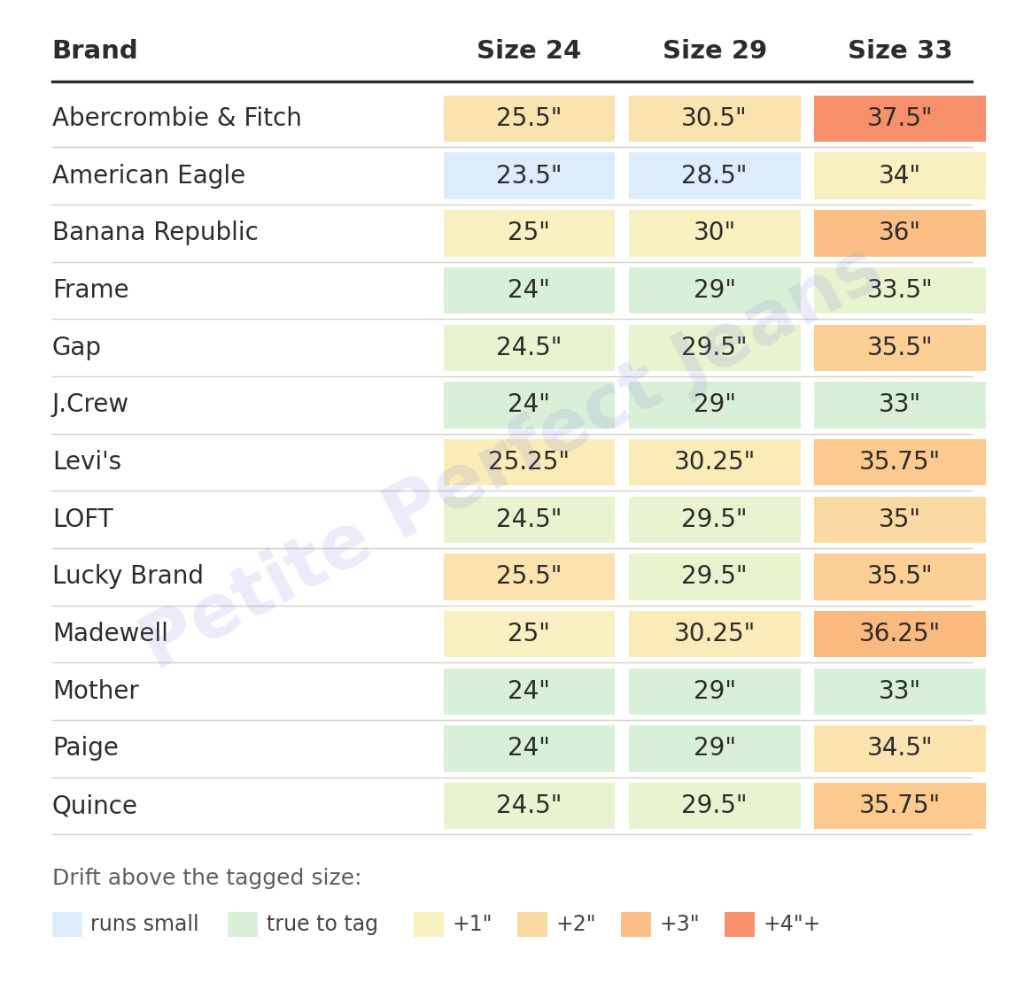
We looked at waist measurements from each brand's own size chart (classic/standard fit). Cell color shows how far the real measurement drifts above the number on the tag; blue runs small, green is true to size, deeper orange is more vanity inflation:
Data note: measurements are from each brand's published women's denim size chart (classic/standard fit, regular length) as of July 2026. Brands revise charts periodically; spot-check before citing.
Review that table slowly, because it explains years of fitting room confusion:
- A "size 24" spans a 2-inch range. At American Eagle it means a 23.5" waist. At Abercrombie & Fitch and Lucky Brand it means 25.5". Those stores are often in the same mall, frequently shopped by the same person, and they disagree by two full inches about what your size is.
- A "size 29" spans 2 inches too. From 28.5" (American Eagle) to 30.5" (Abercrombie).
- A "size 33" spans 4.5 inches. J.Crew and Mother say 33 means 33". Abercrombie says it means 37.5". That's not a rounding difference: that's three sizes' worth of disagreement on a single tag. And you can see it in the color: the left columns are mostly green, the right column glows orange.
The patterns hiding in the table
Vanity sizing grows with the size. Look at how each brand's row shifts from green toward orange left to right. Levi's size 24 is 1.25" bigger than its label; by size 33 it's 2.75" bigger. Abercrombie drifts from +1.5" to +4.5". Nearly every brand adds progressively more inches at the top of the range while keeping the tag numbers evenly spaced. This is why size consistency feels worse the further you are from a size 24: it objectively is worse.
A few brands still tell the truth (mostly). J.Crew, Mother, Paige, and Frame run true-to-tag through most of their range: size 24 = 24", size 29 = 29". If you know your real waist measurement, these brands' tags actually mean something. Note the "mostly" — even Frame and Paige start drifting above size 30, and J.Crew and Mother are the only ones still honest at 33.
One brand runs small. American Eagle is the reverse of vanity sizing (the blue cells): their size 24 fits a 23.5" waist. If AE is your baseline brand, you'll size down everywhere else, which might explain some confusing fitting-room moments in the other direction.
The same brand can disagree with itself. These are the classic-fit charts. Banana Republic's petite chart runs a full inch smaller than its regular chart at the same tag size (petite 25 = 25", regular 25 = 26"). LOFT's petite and standard charts differ by half an inch. Same brand, same number on the tag, different waist, depending on which section of the website you're in.
Why brands do this
A smaller number on the tag makes shoppers feel good, so sizes have quietly inflated for decades. The drift is uneven because every brand inflates at its own pace, which is precisely why your size doesn't transfer between stores. There's no denim standards body, no required measurement behind a size number. Each brand sizes against its own fit model and its own customer.
For petites, this stings twice. The options are already limited, and every new brand means re-rolling the dice on returns, unless you stop playing the tag-number game entirely.
What to do instead
Shop by inches, not by size:
- Measure a pair of jeans that fits you well around the top of the waistband. Jeans, not your body: the jean's number already includes your fit preferences. (Full how-to in the measurements guide.)
- Use the table above as your decoder. If your ideal jean waist is 26.5", you're a 25 at Abercrombie, a 27 at American Eagle, and between sizes at J.Crew and Banana Republic. All of those are "your size."
- Check the chart every time you try a new brand. Nearly every brand publishes one, usually buried in the product details. Thirty seconds of scrolling beats a return shipment.
- Expect the drift at larger sizes. Above a tagged 30, assume the chart and the tag have parted ways, and trust only the inches.
Skip the decoder work entirely: enter your measurements once in the Jean Finder Tool and compare across all of these brands by the numbers.