
Jeans Glossary: The Petite Guide to Denim Terms
Last Updated: July 14, 2026
Shopping for jeans means running into a lot of vocabulary: rise, inseam, leg opening, curvy, petite. Most product pages assume you already know what these mean. This glossary breaks down each term in plain language, with notes on why each one matters for petite women specifically.
If you're looking for how to take your own measurements, check out the 3 jeans measurements that matter most.
Jump to a Term
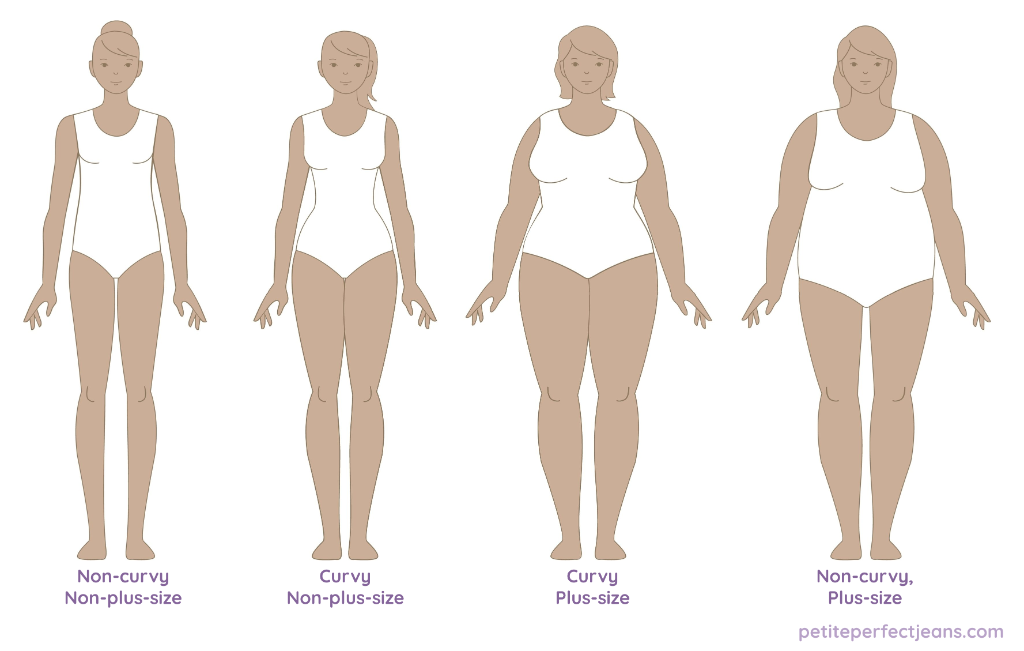
Curvy
What it is: A fit category designed for a bigger waist-to-hip difference. Non-curvy jeans have about a 10" difference between waist and hips while curvy jeans have a minimum 12" difference. Curvy jeans are cut with more room in the hips and seat relative to the waist, so they're less likely to gap at the waistband when they fit your hips.
What to know: "Curvy" isn't about being plus-size or about a specific body shape; it's about the ratio between your waist and hips. Some petite women are curvy fits, some aren't. If you regularly find that jeans either fit your waist and feel tight in the hips, or fit your hips and gap at the waist, you're probably a curvy fit.
Hip
What it is: The circumference of the jean at the fullest part of the hip, usually measured a few inches below the waistband.
What to know: Some brands don't publish hip measurements consistently and "Curvy" options vary in terms of the waist-to-hip difference.
Petite note: If jeans that fit your waist are tight in the hips (or vice versa), the Curvy fit option in the Jean Finder Tool is designed for exactly that mismatch.
Inseam
What it is: The length of the inner leg seam, from the crotch to the bottom hem of the jean. This is what controls where your jeans hit on your leg.
What to know: Standard inseams run 30"–32". Petite inseams typically run 28", with some brands offering shorter options. Cropped and ankle styles in regular sizing can also work for petites, though it's always preferable to find full-length jeans in the right inseam to ensure proportions are scaled for a shorter leg (see knee width for more details).
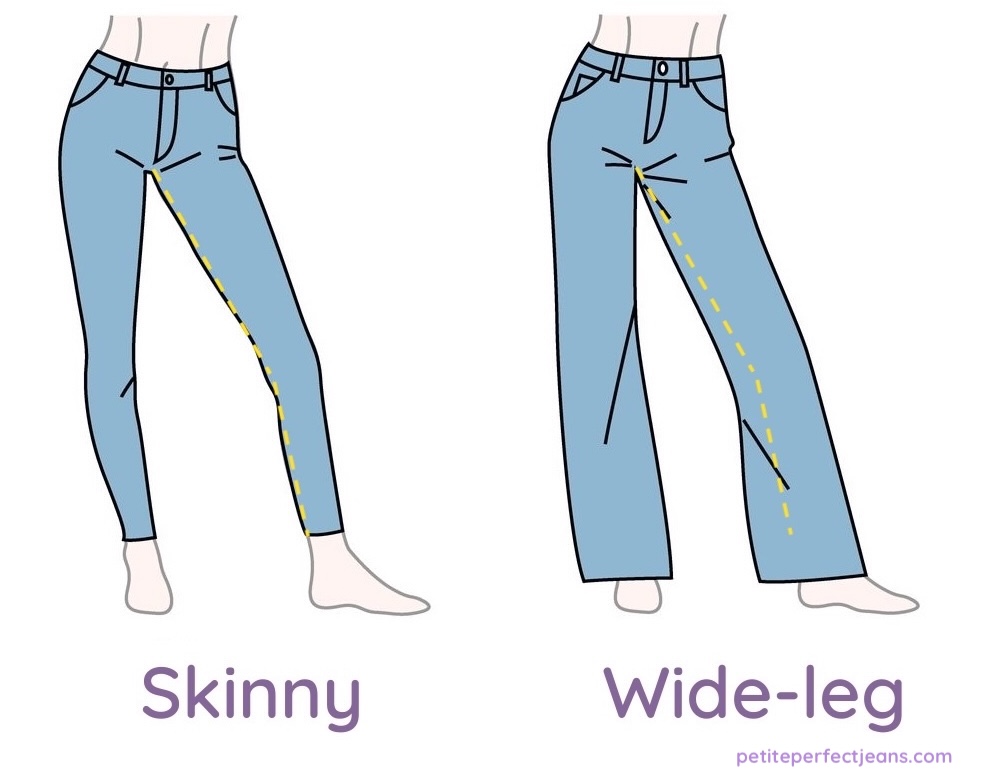
You will have different inseams depending on where you want the jeans to hit, the type of shoes you're wearing, and how the style is cut. This is why you measure the inseam of the jean, rather than your body's inseam. For example, your inseam on a skinny jean will be shorter than that of a wide leg jean since the wide leg jean can drape farther down without looking too long.
Petite note: Even a half-inch makes a visible difference in how jeans hit.
Knee Width
What it is: The width of the jean at the knee, measured flat across. Combined with the leg opening, knee width determines the overall shape of the jean below the waist- whether it tapers in (skinny), stays straight (straight leg), or flares back out (bootcut, flare).
What to know: Knee width is what actually distinguishes a slim straight from a regular straight, or a bootcut from a flare. Two jeans with the same leg opening can look completely different depending on their knee width.
Petite note: Petite jeans position the knee higher because the proportions are scaled for a shorter leg. Wearing a regular-sized jean cropped at the ankle can give you the right inseam, but the knee will hit lower than it should, which can throw off how the whole jean looks, especially on bootcuts and flares.
Leg Opening
What it is: The circumference of the jean at the bottom hem. This can be measured by laying jeans flat, measuring the bottom hem straight across, and multiplying by 2. This determines how much fabric is around your ankle: more narrow for skinnies, and wide for wide legs and flares.
What to know: Skinny jeans typically have leg openings of 9"–11", straight legs around 13"–16", bootcuts around 15"–18", and wide legs anywhere from 18" upward.
Length
What it is: When it comes to jeans, length refers to the inner seam (or inseam) length. (See inseam for more details.)
What to know: While less common with women's jeans, you may sometimes see jean sizing displayed as 25x26 or 25W/26L where the first number (25) refers to the waist measurement and the second number (26) refers to the length or inseam.
Petite
What it is: A sizing category designed for women under about 5'4". Petite jeans aren't just shorter. They're proportioned differently across the whole jean: shorter rise, higher knee placement, sometimes adjusted thigh and leg opening, in addition to a shorter inseam.
What to know: Not every brand uses "petite" the same way. Most brands that offer a true petite line include full proportional adjustments, though some may just shorten the inseam and call it petite. And some brands don't offer petite at all but happen to make styles in shorter inseams that work for petite frames anyway.
Petite note: When a true petite cut is available, it almost always fits better than a regular jean hemmed to the same length because the rise, knee, and other proportions are designed for a shorter frame. Hemming a regular jean fixes the length but leaves everything else where it would sit on a non-petite body.
Rise
What it is: The distance from the crotch seam to the top of the waistband. "Front rise" measures along the front of the jeans; "back rise" measures along the back. They're different numbers, and most brands publish front rise. If it doesn't specify, you can assume front rise on jeans.
What to know: There's no industry standard for what "low," "mid," and "high" rise mean in inches. Even within a single brand, the same rise measurement will be called 2 different descriptions. See blog post: rise labels are lying for more details.
Short
What it is: While petite sizing is for short women, the term "short" when it comes to jeans usually refers to a shorter length or inseam. By contrast, petite usually refers to jeans being proportionally resized to petites, which may include adjusting the rise, knee placement and other proportions.
What to know: See inseam for more details.
Waist
What it is: This can refer to either the body waist measurement or the jean waist measurement. Most brands' sizing refers to the body waist measurement, which is measured at the narrowest part of your waist. We recommend using the jean measurement: the circumference of the jeans at the top of the waistband. This is the actual measured waist of the jeans, not the size on the tag. This gives you a more direct comparison across jeans themselves.
What to know: Vanity sizing means a "26" on the tag might actually measure 27" or 28". Brands aren't consistent with each other, and some aren't always consistent within their own jeans. Even when you have actual waist measurements, there's no substitute for trying on jeans.
Putting It All Together
Waist, inseam, and rise are the foundation of fit, which is why they're what the Jean Finder Tool uses to match you with jeans. The other terms are useful context once you know your basics. They help you understand why two jeans that match your core measurements can still feel different.
If you haven't taken your measurements yet, start with the 3 jeans measurements that matter most. Then head to the tool to see what matches.
Anything else you want defined? Send a note to hello@petiteperfectjeans.com!