
How to Adjust Your Measurements for the Fit You Actually Want
This guide assumes you've already measured a pair of jeans that fits you well. If you haven't done that yet, start with the measurements guide. It walks you through finding your waist, inseam, and rise from an existing pair of jeans.
Why Measure Jeans and Not Your Body?
Normally, when people think about taking measurements, they think about their own body measurements, not the measurements of the clothes. The reason we recommend measuring a pair of jeans that fits you well is that it serves as a better starting point for getting jeans that factor in both your measurements and your preferences around how you like jeans to fit you personally. For example, while your measured waist may be 27", maybe you prefer a looser fit at 27.5" or even 28".
Once you have these baseline numbers, you can use them to inform other jean purchases of a different style. How jeans actually look and feel on you depends on what shoes you're wearing, what style you're going for, and where you want the jeans to sit on your body. This guide is about going from "these jeans match my measurements" to "these jeans are exactly what I want."
Waist: Your Number Is Consistent, But the Labels Aren't
Whether you're petite or not, your waist is your waist, right? Yes…and no. Finding the right waist size is not simple, because the labels are unreliable in two different ways.
Vanity sizing means the number on the tag isn't the actual measurement. A size 28 jean often measures anywhere from 27.5" to 29" at the waist. The gap tends to grow at larger sizes with a size 34 usually meaning a 36–39" natural waist. This is why two pairs labeled the same size can fit completely differently. The numbers just don't mean the same thing everywhere. What to do with this: treat the size label as a rough starting point, not a guarantee.
Where the jeans sit changes which measurement matters. Sizing charts almost always reference your natural waist, the narrowest part of your torso. But depending on the rise and style, the jeans themselves may sit above, at, or below that point, and your body has different measurements at each of those spots. A high-rise jean that's supposed to hit at your natural waist and a mid-rise that sits at your hip are measuring two different things, even if both are labeled for the same "waist size."
Practical advice: when you can, try on multiple waist sizes in the same style, especially if you're between numbers or switching rises.
Inseam: It Depends on More Than Your Leg Length
The inseam you measured from your favorite jeans tells you what length works with the shoes you usually wear with those jeans, in that specific style. Change either one, and the right inseam changes too.
Shoes matter. A pair of jeans that hits perfectly with sneakers will be too short with heeled boots. Jeans that look great with block heels might pool on the floor in flats. The simplest approach: try jeans on with the actual shoes you plan to wear them with. If you're ordering online, think about which shoes you'll pair with them most often and use that as your baseline. Shopping for jeans to wear with heels but your current pair lives with flats? You'll likely want a longer inseam than what you measured.
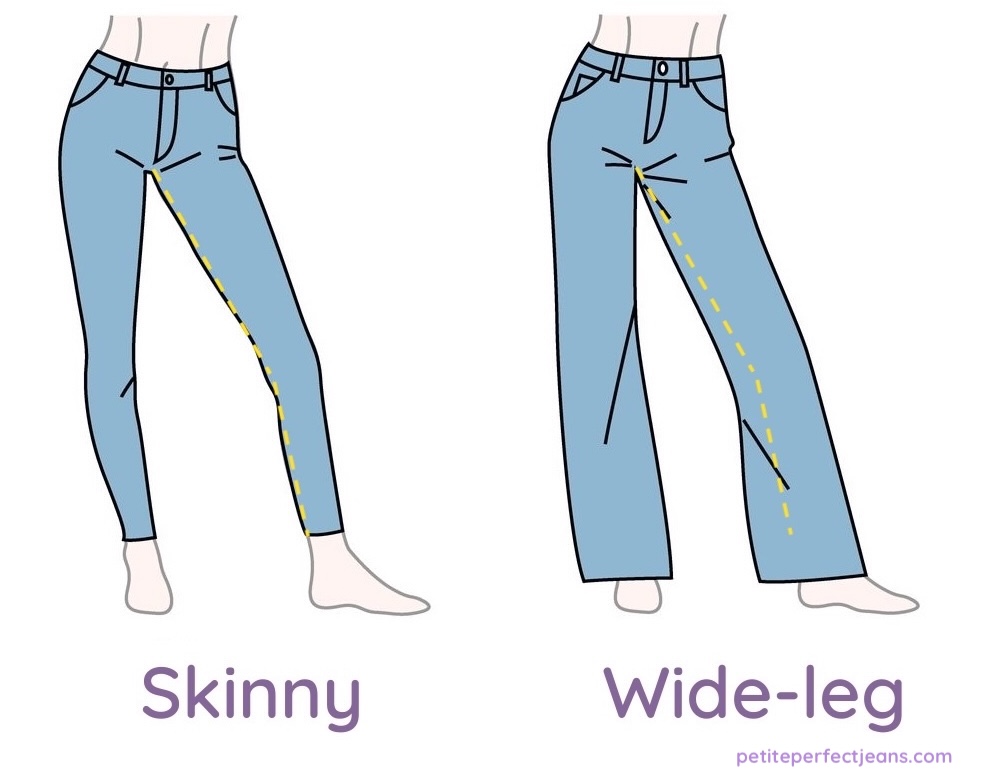
Style matters too. A skinny jean hugs your leg all the way down, so the hem hits exactly where the inseam says it will. A wide leg flares away from your body below the knee; the fabric drapes instead of clinging, which means a longer inseam can actually hit at the same spot on your ankle. A wide leg with a 27" inseam might land where a skinny with a 26" inseam does. So if you're using the tool to find wide legs or flares, don't automatically rule out matches with slightly longer inseams than your skinny jean baseline. Straight legs and bootcuts fall somewhere in between.
A note on wearing cropped/ankle jeans as full-length: It's common for petites to buy jeans in a cropped or ankle length from regular sizing, and while that can work for getting the right inseam, keep in mind that petite-specific sizing adjusts more than just length. Petite cuts are proportioned differently; the rise is shorter, and the knee hits in a different spot. A regular cropped jean might give you the right hem length but still look off because the knee break and rise weren't designed for a shorter frame. When it's available, petite sizing will almost always give you a better overall fit. If going the cropped or ankle route, jeans with less variation in knee width can work better, such as straight or wide-leg.
Rise: Ignore the Label, Trust the Inches
When a brand calls something "mid rise," they're describing where they expect the jeans to sit, but that expectation is based on an average-height frame. On a shorter torso, the same rise sits higher. A 10" rise labeled "mid" can feel solidly high-rise on someone who's 4'11" or even go up to your ribcage on a short-torso petite.
This is why the tool matches on actual inches instead of labels. But it also means you should think about what you want, not what the brand says the rise is supposed to be.
Start with what you know. Measure the rise on a pair of jeans you already like. That number is your reference point. If you want your next pair to sit higher, look for a longer rise. If you want them lower, go shorter.
Try them on standing, walking, and sitting. Rise feels different in motion than it does standing still. Walking can reveal bunching at the waist that you won't catch in a static mirror check, a sign the rise is too high for your torso. Sitting is equally telling: a rise that's comfortable standing might bunch or fold awkwardly when you're seated. If you're seeing folds in the crotch area, the rise is too high for your proportions specifically.
Quick Reference: Adjusting From Your Baseline
Start with the measurements from a pair of jeans that fits you well. Then adjust:
- Waist: Your waist measurement stays the same, but try on multiple waist sizes, especially if you're buying a different style or brand than the jean you measured.
- Inseam: Add length for heels or wider/drapier styles. Subtract for flats or slimmer styles.
- Rise: Add if you want jeans to sit higher than your baseline pair. Subtract if you want them lower. Ignore the brand's label; go by inches.
Ready to start? Head to the Jean Finder Tool with your measurements and see what matches.
Try the Jean Finder Tool →